
Of all the culture shocks Japan has in store for an American visitor, the one that stops people at the door of a hot spring is the simplest and the hardest: you go in completely naked. No swimsuit, no exceptions, no polite workaround. In a traditional Japanese onsen, the hot-spring bath that is one of the country’s great pleasures, clothing in the water is not just unnecessary, it is forbidden, and the swimsuit an American reaches for out of modesty is the one thing guaranteed to get them stopped. For many visitors this is the wall they cannot climb, the single rule that quietly keeps them out of one of the most restorative, soul-settling experiences the whole country offers. They go all the way to Japan and skip the hot spring over a swimsuit, which, once you understand the place, is a genuine shame.
And yet the Japanese response to the American’s discomfort is not apology but gentle puzzlement, because to them the nudity is not an awkward side effect of the bath. It is the entire point. Here is the rule, the washing ritual that surrounds it, the one catch nobody warns you about, the thousand years of tradition behind it, and the quietly beautiful idea that turns the thing Americans dread into the thing locals treasure. It is far easier, and far lovelier, than the one scary rule makes it sound.
What follows is the rule itself, the washing ritual that matters even more, the tattoo catch, why locals insist the nudity is the point, and how to do it without losing your nerve.
The Rule: Naked, and No Negotiating
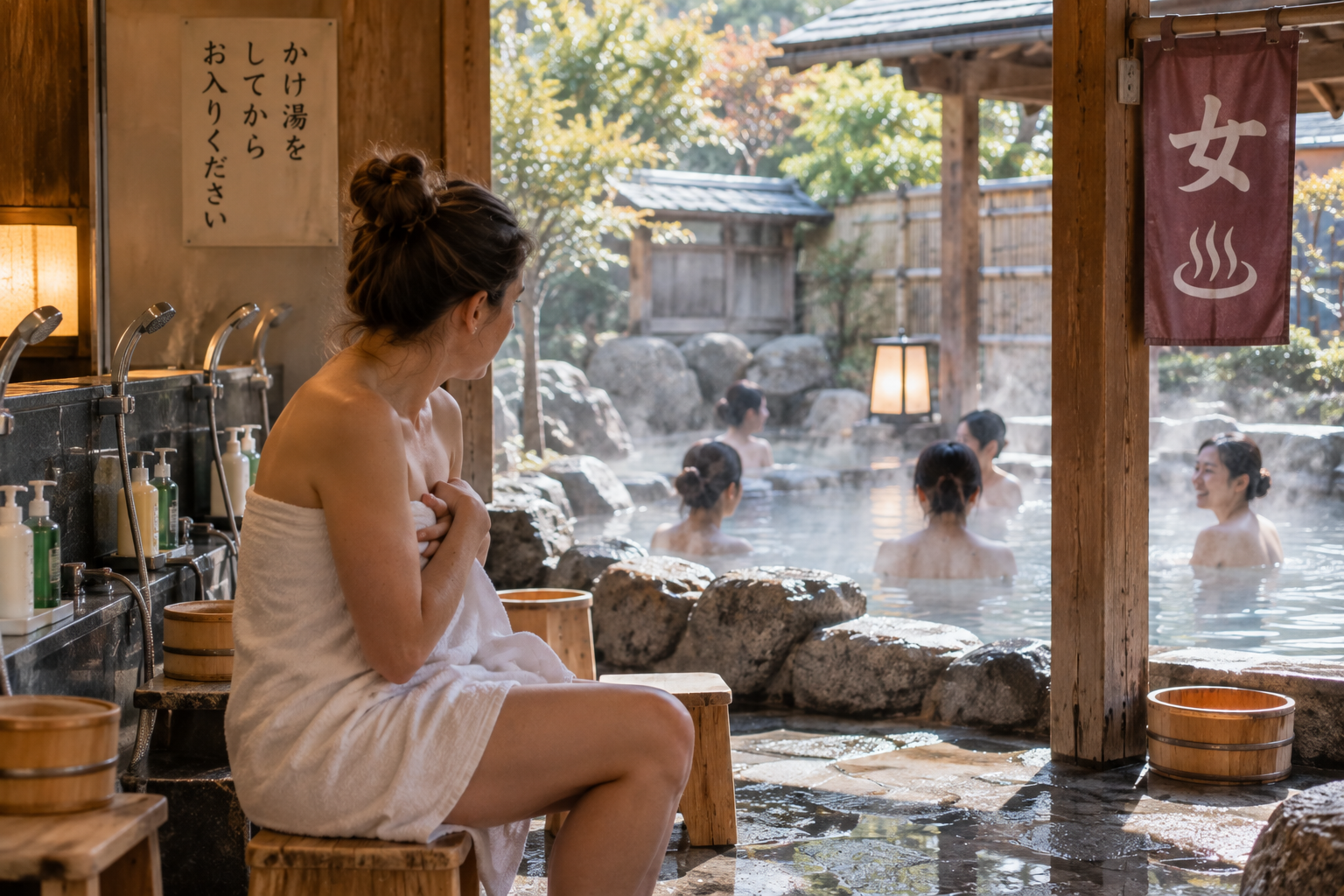
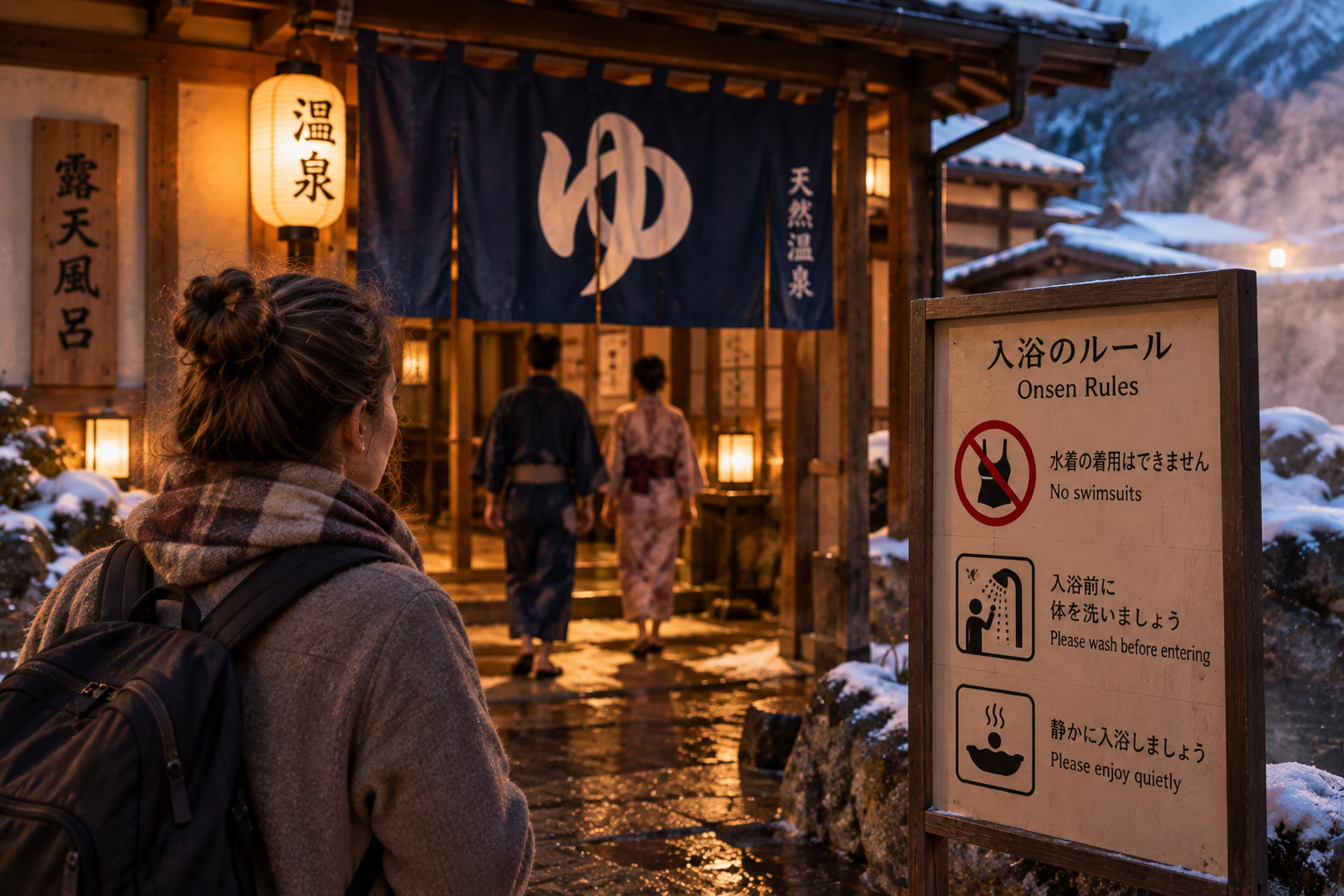
The rule is absolute and it surprises almost every first-timer: in a traditional onsen, you bathe completely nude, and swimwear is not allowed. This is not a suggestion or a loose custom; it is the firm expectation, and at many places wearing a swimsuit will get you politely but firmly turned away, because to the Japanese a swimsuit that has been out in the world is unhygienic, a dirty thing that would contaminate the clean communal water. The thing an American puts on for modesty is, in onsen logic, the one genuinely unclean object you could bring into the bath, which is a complete inversion of the instinct you walked in with. Your clothing is the problem; your clean, washed body is not.
There is one piece of good news that softens the shock, and it is worth knowing upfront: the vast majority of traditional onsen are separated by gender, with entirely separate bathing areas for men and women. So the nudity, daunting as it sounds, is same-sex nudity, more like a locker room than anything else, not the mixed bathing many foreigners imagine when they first hear the rule. Truly mixed-gender bathing, called konyoku, still exists in a handful of rural and historic places but has become quite rare, and where it survives it often permits a towel or swimwear precisely because it is the exception that proves the rule. The default onsen experience is firmly single-sex, and that is the one you are overwhelmingly likely to encounter. For the ordinary onsen experience, then, the rule is simply this: you will be naked, among others of your own gender, and the swimsuit stays in the locker. Once an American absorbs that it is single-sex, essentially a quiet, warm, same-gender locker room where everyone happens to be soaking rather than changing, the wall that looked unclimbable gets a good deal lower, and often disappears altogether.
The Ritual That Matters More Than the Nudity
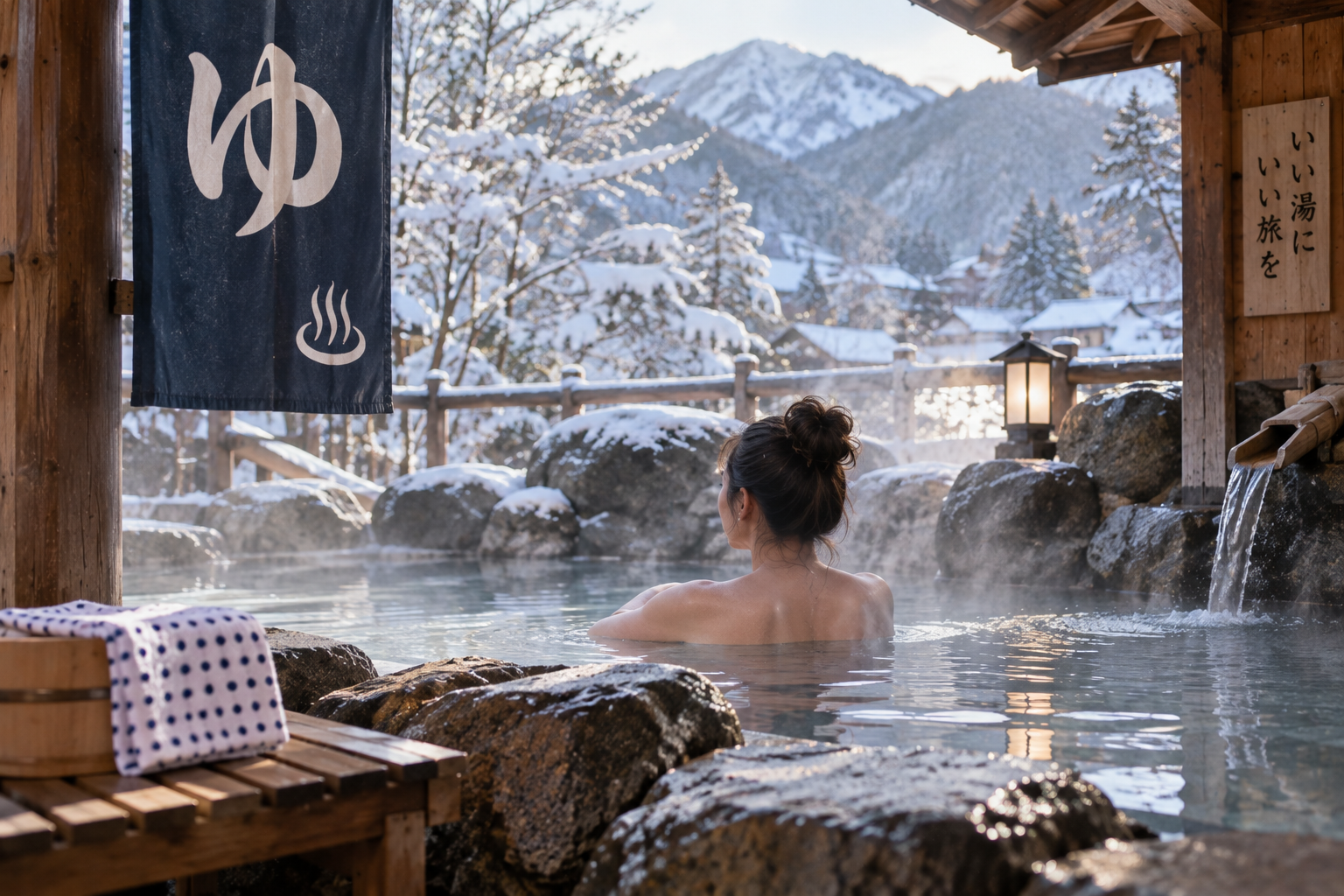
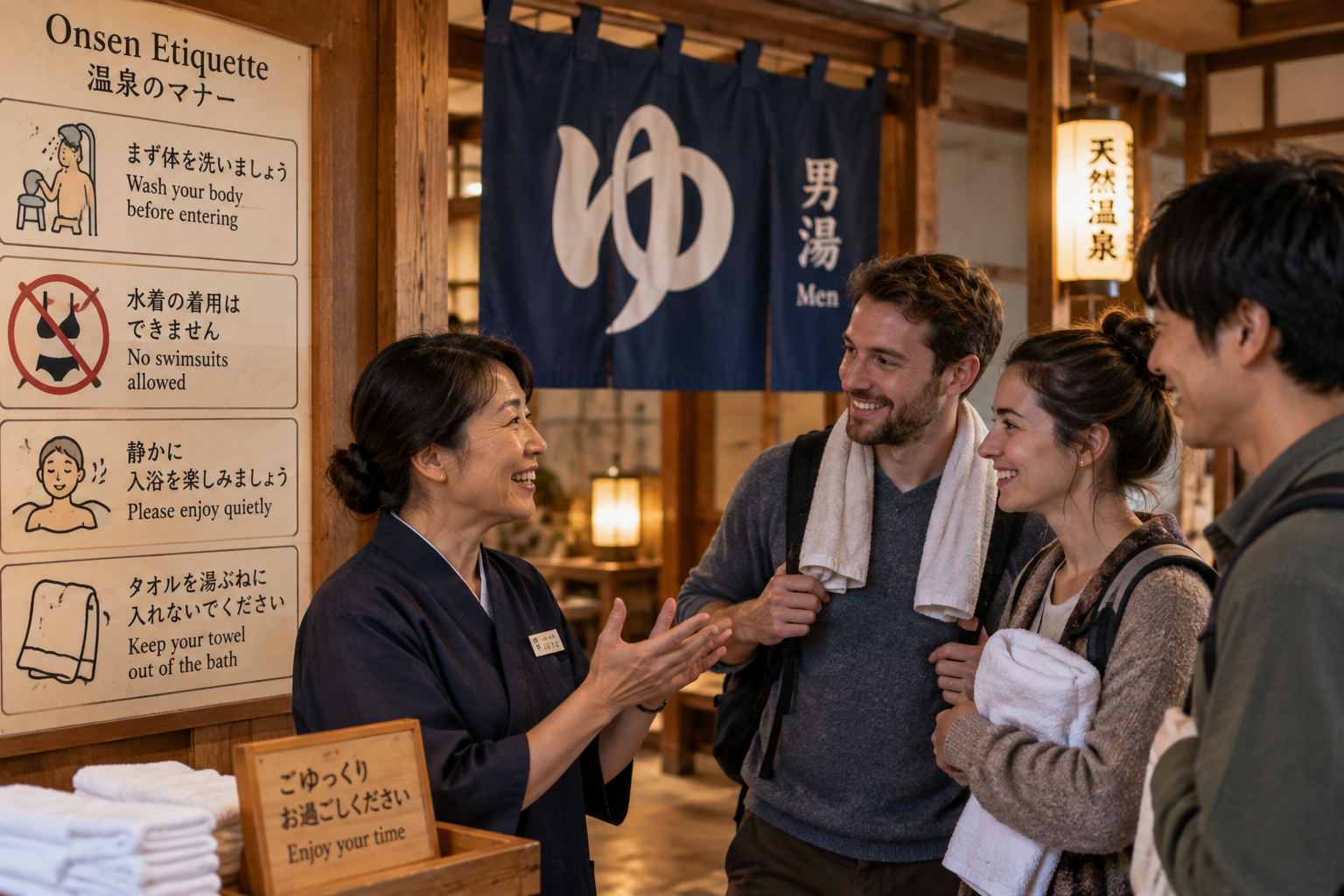
Here is the thing most guides bury and that actually matters most: the onsen is built around a washing ritual, and getting that right matters far more than your feelings about being undressed. Before you so much as dip a toe in the hot spring, you must wash your entire body thoroughly at the shower stations provided, sitting on a small stool in front of a handheld shower, with soap and shampoo laid out for you, scrubbing yourself clean from head to toe. This is the golden rule of onsen etiquette, non-negotiable, and the reason is simple: the bath itself is for soaking only, never for washing, so everyone enters already clean and the shared water stays pure for the next person.
Then there is the small towel, the one object you carry with you, and it has its own strict rule. It is for washing and for a bit of modesty as you move around, but it never, ever touches the bath water; bathers typically fold it and rest it on their heads while they soak. When you are done, you use it to wipe the water off your body before you step back into the changing room.
None of this is complicated, but all of it is expected, and the beauty of focusing on the ritual is that it gives your self-conscious mind something to do. Wash properly, keep your towel out of the water, soak quietly, and you are doing it right, and the nudity, the thing you dreaded, quietly recedes behind a set of small, calming tasks. The ritual is the thing; the nakedness is just the condition it happens in, and within a few minutes of washing and settling into the hot water, most people forget to think about it at all. The body stops being a problem the moment there is a procedure to follow.
The Tattoo Rule Nobody Expects
There is one more rule that blindsides foreign visitors, and it has nothing to do with modesty: tattoos. At most traditional onsen, tattoos are prohibited, and the ban can be surprisingly strict, catching even a small, tasteful design on a shoulder or ankle. The reason is historical and particular to Japan: tattoos have long been associated with the yakuza, Japan’s organized crime, so bathhouses banned them to keep that element out, and the rule has lingered long after the association has faded for most people. To a tattooed American for whom ink is ordinary self-expression, being turned away is a genuine and unexpected shock.
The good news is that the situation is softening and there are real workarounds. A growing number of tattoo-friendly onsen now welcome inked guests, especially in big cities and tourist areas, and directories exist to help you find them. For a small tattoo, a waterproof cover sticker or bandage, sold specifically for this purpose, is often enough to pass without any trouble at all. Many travelers with modest ink get in this way without ever being questioned.
And for anyone who would rather not worry about it at all, the cleanest solution is to book a private bath, a kashikiri, often available at a ryokan inn, where you bathe alone or with your own group and no rule about tattoos applies. So tattoos are a real obstacle at traditional public onsen, more real than most Western visitors expect, but a very navigable one with a little planning, and absolutely no reason to miss the experience entirely. A sticker, a tattoo-friendly facility, or a private bath solves it every time.
Why Locals Say the Nudity Is the Point
Now the heart of it, the idea that reframes the whole thing. Ask Japanese people why the nudity matters and you will hear something that sounds, to an American, almost philosophical, because there is a concept at the center of bathing culture called hadaka no tsukiai, which translates roughly as naked association, or naked communion. The idea is that when everyone is undressed, all the markers of status that clothing carries, the expensive suit, the cheap coat, the uniform, the brand, simply vanish, and for the length of the bath everyone is reduced to the same unadorned human equality. The banker and the laborer, the boss and the new hire, the local and the stranger, soak side by side in the same hot water with absolutely nothing to signal who is who, no watch, no suit, no logo, no tell. For the length of the bath, the usual hierarchy of the Japanese world, which is otherwise quite real, simply dissolves into steam.
This, locals will tell you, is not a drawback to be tolerated but the very value of the thing. Stripped of clothes, people are stripped of pretense, and a particular kind of honesty and closeness becomes possible that the clothed, ranked, status-conscious everyday world simply does not allow. You cannot perform your importance with no pockets to put it in.
It is why colleagues and friends and families bathe together, why business relationships in Japan have historically been sealed over a shared soak, why the onsen is considered a place of genuine connection rather than mere hygiene. The nudity is not incidental to that equality; it is what produces it. So when an American squirms at being naked and a Japanese bather looks on, mildly baffled that anyone would make a fuss, the gap between them is not really about bodies at all, or even about modesty. It is that the American sees nudity as exposure and vulnerability, while the Japanese bather sees it as the thing that makes everyone, for once, equal and at ease. The nakedness an American is trying to get past is the exact feature the locals treasure most, which is why the whole encounter is less a clash of comfort levels than a small, quiet lesson in seeing the same thing through two completely different sets of eyes. Learn to see it their way, even briefly, and the discomfort has nowhere left to stand.
A Ritual Older Than Almost Everything
It helps to understand that the onsen is not a spa amenity bolted onto modern Japan but one of the oldest living rituals in the culture, which is part of why the rules feel so settled and why the Japanese treat an outsider’s hesitation with such patience. Japan sits on one of the most geothermally active patches of earth on the planet, dotted with thousands of natural hot springs, and people have been bathing in them for well over a thousand years, long before most of what we think of as Japanese culture took its modern shape. Bathing here is not about getting clean, which the shower already handled; it is about rest, restoration, and a particular communion with nature and with one another.
That long history runs right through everyday life. Alongside the resort onsen there is the sento, the humble neighborhood public bathhouse, where ordinary people have soaked together for generations, and the ryokan, the traditional inn where a hot-spring bath is the centerpiece of a stay. There is a deep seasonal dimension too, the pleasure of an outdoor bath, a rotenburo, with snow falling on your shoulders or autumn leaves drifting past, that Japanese bathers prize above almost anything. All of this is to say that when you step into an onsen, you are not trying a quirky local amenity; you are joining a ritual that has soothed and leveled and connected people on these islands for more than a millennium, and the one rule you were nervous about is simply the door you walk through to reach it. Knowing the weight of the tradition tends to make the nervousness feel smaller, and the experience larger.
How to Actually Do It Without Losing Your Nerve
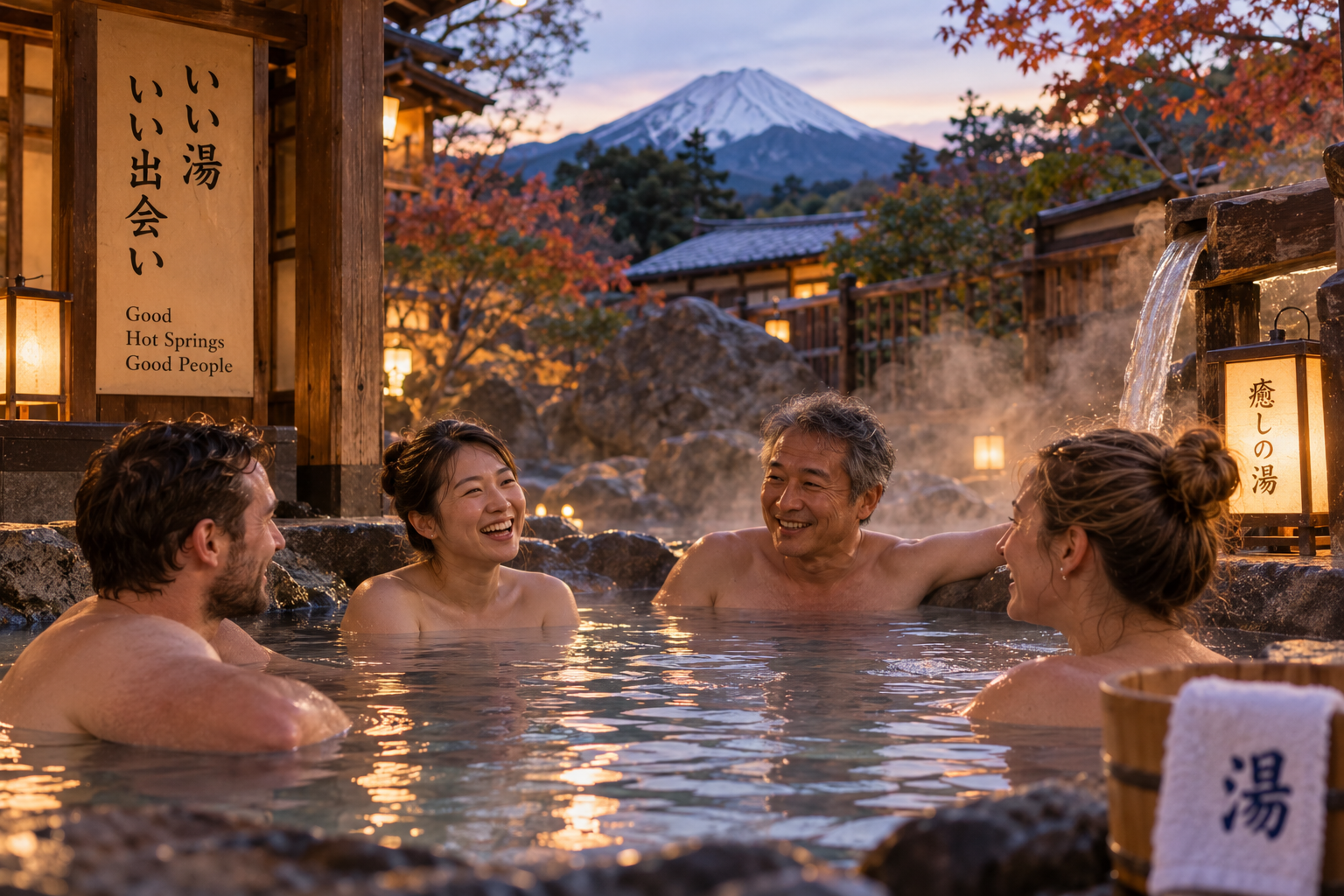
So how does a nervous American actually get into the water? The first and most reassuring fact, again, is that it is almost always single-sex, so whatever discomfort you are bracing for is the familiar discomfort of a locker room, not something stranger. The second is that, as absolutely everyone who has done it reports, no one is looking at you. The onsen is a quiet, contemplative, deeply relaxed place, closer to a library than a pool, and the other bathers are far too absorbed in their own soak, their own thoughts, their own hard-won peace, to pay the slightest attention to your body or anyone else’s; the self-consciousness you carry in finds nothing to feed on and fades within minutes, usually sooner than you would ever believe from the nervous side of the door.
A few practical things smooth the path. Focus on the ritual rather than your nerves: wash thoroughly, manage your little towel, move calmly, and let the steps occupy you. Carry the small towel for a sense of cover as you walk to and from the bath, even though it comes off to soak.
If the idea of a public bath is genuinely too much to start with, or if you have tattoos, book a private onsen at a ryokan and have the entire experience to yourself, which is blissful in its own right. And hold onto the locals’ perspective, because it genuinely helps: you are not exposing yourself to strangers, you are joining a centuries-old ritual of rest and equality in which being undressed is simply the price of admission and the source of the calm. Step past the one rule you could not get over, and what waits on the other side is one of the most restorative hours Japan can offer you, body loose in mineral-rich hot water, mind gone quiet, the whole clenched business of travel melting away in a tradition that has been soothing people in exactly this way for longer than almost anything else in the culture. The swimsuit was never worth missing that.

About the Author: Ruben, co-founder of Gamintraveler.com since 2014, is a seasoned traveler from Spain who has explored over 100 countries since 2009. Known for his extensive travel adventures across South America, Europe, the US, Australia, New Zealand, Asia, and Africa, Ruben combines his passion for adventurous yet sustainable living with his love for cycling, highlighted by his remarkable 5-month bicycle journey from Spain to Norway. He currently resides in Spain, where he continues sharing his travel experiences with his partner, Rachel, and their son, Han.